Monday, March 7, 2016

Cass Lake, Minnesota

1,686 miles

March 7 – In a dramatic contrast to the 90%+ Norwegian Lutheran territory I’d been travelling through, the town of Cass Lake is 67.9% Native American and 6.6% from two or more races.  (24.3% White, 0.3% African American, 0.8% Asian, 0.1% from other races)  Cass Lake, with 770 people, is located within the boundaries of the Leech Lake Indian Reservation.  It is the headquarters location of Minnesota Chippewa Tribe and Leech Lake Band of Ojibwe, as well as the Chippewa National Forest.  Students can choose to attend either the Cass Lake–Bena public schools or the Bureau of Indian Affairs-funded Bug-O-Nay-Ge-Shig School in nearby Bena.  Leech Lake Tribal College, a two-year tribal college, is also located approximately 3 miles northwest of town.

Forest Supervisor's log building
In 1933, following passage of the Emergency Conservation Work Act and establishment of the Civilian Conservation Corps, Cass Lake was the headquarters for the Chippewa Sub-District, responsible for management of over a dozen work camps. Among the CCC projects completed in Cass Lake were the monumental log-construction Forest Supervisor's Office (1936) and establishment of the Lydick Nursery (1934), which produced millions of seedlings for reforestation work.  

After a century of clear-cut logging and then agricultural use, Minnesota is working to reestablish its forests.  The Today, the reforestation of Minnesota is actively promoted by the Department of Natural Resources, commercial seed companies, and volunteers.
tree seedlings
Lots of outdoor recreational activities are offered around here, and this is an idyllic image of cabin-camping on the shore of Cass Lake.


info: Wikipedia.com

Sunday, March 6, 2016

Bemidji, Minnesota

Ojibwe-Anishinabe symbol
1,672 miles

March 6 – The name of Bemidji derives from Ojibwe words meaning "a lake with crossing waters", probably referring to the connection between Lake Irving and Lake Bemidji.

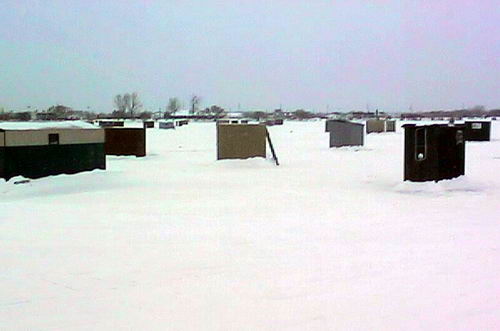
ice-fishing shacks on Lake Bemidji

The Minnesota Department of Natural Resources reminds owners of ice-fishing shacks that spring is on its way, and the last day for ice houses to be on state lakes is coming up soon.  

Ice conditions can vary greatly, and anglers should know about the different types and characteristics of ice. Slush shows weakening of ice and should be considered a danger sign. If ice at the shoreline is cracked or squishy, people should stay off. People should not go on the ice during thaws. 

Honeycombed ice, dark snow and dark ice should be avoided. Ice is generally thinner where there is moving water, such as near inlets and outlets, bridge abutments, islands and other objects that protrude through the ice.

ice augur
The DNR recommends checking ice thickness with an auger before venturing onto a frozen pond, lake, or river. According to the DNR’s Boat and Water Safety Unit, a minimum of 4 inches of new, clear ice is necessary for ice fishing; snowmobiling or ATV activity requires at least 5 inches; 8 to 12 inches are needed to support a car or small pickup; 12-15 inches are need for a medium truck.

This year's deadline for removing ice-fishing shacks here in the northern third of Minnesota is March 21st.  Interestingly, even after removal dates, shelters may remain on the ice between midnight and one hour before sunrise if they are occupied, but storing or leaving shelters on a public access is prohibited. 

Conservation Officer Tony Salzer of Ham Lake notes:  “Please remove your ice shelters early if ice conditions begin to deteriorate.”  If owners fail to comply with this ice house removal deadline, they can be fined, and the house contents confiscated or destroyed.  Conservation officers do not want to be fishing sunken shacks out of lakes this spring.


Saturday, March 5, 2016

March 5 – travel & exercise change-up

Feeling good!  Changing up my exercises every third day is accomplishing most of what I wanted.  On the third day, I’m doing upper body weightlifting & posture activities on my home gym.  Also leg-lifting that works muscles not touched by cycling.  I’m walking better!  Cycling is less drudgery when I go back to it.  Some of my blog-writing time is freed up for the historical research that motivated me to start this project.  My progress across the continent is slower, but the journey is plenty of fun.


Some of my friends are already suggesting other routes to take the next time I (virtually) go cross-country and other virtual bike trips I could take.  The exploration & discoveries provide reasons to keep me going.

Friday, March 4, 2016

Wilton, Minnesota

1,658 miles

March 4 – Wilton is located within Eckles Township, and the townsfolk have been playing around with that name for years.  The post office was first named Selkce, 1900-1903 (Eckles spelled backwards), and then changed to its present name.  On various maps, the site is also shown as Eckles and Eckels.

Grant Lake
Wilton, with a 2010 population of 204 residents, is described as a bedroom community for Bemidji, but it does not look like a suburb.  It has a few streets with nondescript houses, but no amenities or discernible center of community life.  Nearby is a county park with a picnic shelter, a play structure, and a swimming area in Grant Lake.

I saw mention of a quilt shop in Wilton, but Google Maps was unable to locate it.  I got 3 different addresses for Sadie Rae’s Quilt Shop, and the only one with a photo on Google Street Views showed a small white house with no parking space or sign.  Google’s idea of where the Post Office was located was just as ridiculous.  I was ready to conclude that the shop, wherever it had been located, had gone out of business.  The shop does not have its own website, but I saw it listed on Quilting Hub’s online directory, updated within the past 2 months, and I couldn’t let go of this mystery.  
Sadie Rae's Quilt Shop (as seen from the highway)

So I called the phone number listed on Yelp and talked to Shelly.  She gave me driving directions from Bemidji while I “drove” along US Rte. 2 on Google Street Views.  When I got to the vicinity (just off Rte. 2, not in town), switched to Earth View to search building by building to find the one where the shop is located.  It’s on the highway access road just off Rte. 2, between the red-roofed bank and the brown-roofed bar.  Whew!  What a search!  I’m glad I wasn’t doing that by bicycle!

The Great Northern Railway and the Soo Line both had stations through Wilton in the past.  Now there is an old railroad bed labelled by Google as “Abandoned Railroad”.  Shelly told me that it has been converted to a hiking & biking trail, and it appears that it is also used for off-road ATV riding.


Abandoned Railroad image: Google Earth Views

Thursday, March 3, 2016

Bagley, Minnesota

sundog photo by Terry Lamppa
1,644 miles

March 3 – Sundogs are one type of a large family of halos, created by light interacting with ice crystals in the atmosphere.  They’re also called mock suns, phantom suns, or (scientifically) parhelia.  Sun dogs typically appear as a pair of bright spots on either horizontal side of the Sun, with a luminous ring known as a halo.  Sundogs are best seen and are most conspicuous when the Sun is close to the horizon.  An icy place in a high latitude in the early morning created this spectacular Bagley sundog.

asparagus shoots
The growing season in Bagley is very short.  At the Ter-Lee organic gardens, the first spring crop is asparagus in May!  The first tender shoots appear about the same time as the dandelions arrive and continue for about six weeks.  Presumably, the hardy dandelions continue to flourish until late fall.


Wednesday, March 2, 2016

Great-Uncle Jacob Edgerton, Sheriff of Rutland

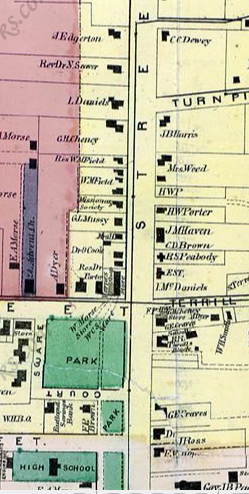
March 2 – I found Uncle Jacob!  He is Hattie’s great-uncle Jacob Edgerton, her grandmother Esther Edgerton Blakely’s half-brother.  We have old photo albums from the period which probably include a portrait of them, but the photos were left unlabelled.

Jacob Edgerton was elected the 14th Sheriff of Rutland County in 1830, a position he held for many years.  He also held other offices and engaged in business during those years.  He served as Sheriff of Pawlet, starting in 1840 after some years as a Deputy Sheriff there.  He continued simultaneously as Sheriff of Rutland County and as Sheriff of Pawlet until 1861.  He became the U.S.  Assistant Collector of Internal Revenue for Rutland during the administration of President Lincoln, at least in 1865-6.

Uncle Jacob's house (upper left)
north of High School (lower left)
Jacob Edgerton lived at 72 Main Street in Rutland with his wife Narcissa and their children.  In 1850, their teenagers, William Gregory and Catherine Narcissa were living at home.  Two other children, Julia and Rollin, had died as small children. 

By 1867, when Hattie was in Rutland for school, both William and Catherine had left home.  Great-Uncle Jacob was 67 years old, Great-Aunt Narcissa was 62.  According to the 1870 census record, a Kate Allen and her 12-year-old daughter Hattie were living with them.  Kate’s age of 36 years matches Catherine’s birthdate of 1833.  Because Kate is not listed as a “domestic servant” but rather “at home”, it would indicate that she is the grown daughter of the house with her daughter, either visiting or residing with her parents because she has been widowed.  Three years earlier, when Hattie Blakely visited, she did not mention her great-aunt or a cousin who was also named Hattie.  So, probably, Jacob and Narcissa were living alone at that point.


Edgerton family gravestone in Rutland
Jacob’s job as Sheriff involved quite a bit of travel around the county.  This may explain why there is no census a record of him, but it is still a mystery why even Narcissa and the children were left out.  In the census records for this year, many errors have been found.  In 1870, Jacob was the U.S. Assistant Tax Assessor for Rutland.  In 1880, at the age of 80, he was a bank director.  Jacob and Narcissa both died in 1886.

Tuesday, March 1, 2016

Fosston, Minnesota, tall tales

1,630 miles

March 1 – Fosston was named for Louis Foss, an immigrant from Norway who started one of the first businesses in the community.  Louis Foss & Company was probably a general store, which every town needed from the start.  Saskatchewan also has a little hamlet of Fosston, but no information could be found about its namesake.

Cordwood Pete & Tamarack
The town of Fosston was said to be the adopted hometown of Cordwood Pete, the lesser-known younger brother of the legendary giant lumberjack Paul Bunyan.  The younger brother Peter Bunyan was a mere 4 feet 9 inches in height. Pete's growth was apparently stunted because Paul ate everything in sight.
According to the tall tales, Paul Bunyan left his home in Bangor, Maine, to make his way in the world, and ended up in the north woods of Minnesota where he excelled as a lumberjack. Pete followed Paul to Minnesota and found work as a lumberjack near Fosston.  Local lumberjacks nicknamed him "Le Dang Cordwood Pete" because his size suggested he was more suited to cutting cordwood than felling huge trees. Pete spent much time in the local saloons, and his fellow lumberjacks soon learned he was hot tempered and full of spunk. They came to admire his feisty spirit, and no one dared fight him.

Legend has it that he "borrowed" his brother's double-bladed ax one day. He swung the ax, and its weight kept the ax spinning around and around as if in perpetual motion. When the ax finally stopped spinning, 100 acres of timber had been felled. The railroad hired Pete the next day to clear a path for their tracks, and before the day was over, he had clear-cut fifty square miles of timber. Pete had to give his brother's ax back to him the next day, and he never again achieved such a lumberjacking feat.  After that, Pete stuck to cutting cordwood which he hauled to market with the help of his little donkey named Tamarack.

Fosston tourist attraction statues
The story of Cordwood Pete had been all but forgotten until the spring of 2001 when a time capsule was discovered by a work crew demolishing one of Fosston's oldest buildings. Inside was the complete story of Cordwood Pete.

Some historians of folklore have called the tall tales about Paul Bunyan "fakelore", referring to modern stories passed off as older folktales.  It seems that stories about Paul Bunyan have been used in many former lumbering regions to boost tourism.  And it is quite possible that the legend of Cordwood Pete may also qualify as "fakelore."  The author of the Cordwood Pete legend may have been Arvid "Clem" Clementson, a former mayor of Fosston.  It seems to me that the difference between tall tales and “fakelore” is a fine distinction for academics.  It’s all preposterous fiction, made up by one storyteller or a series of revisionists.


info: Wikipedia.com